Now You Can Join the Legendary Glass House Conversations


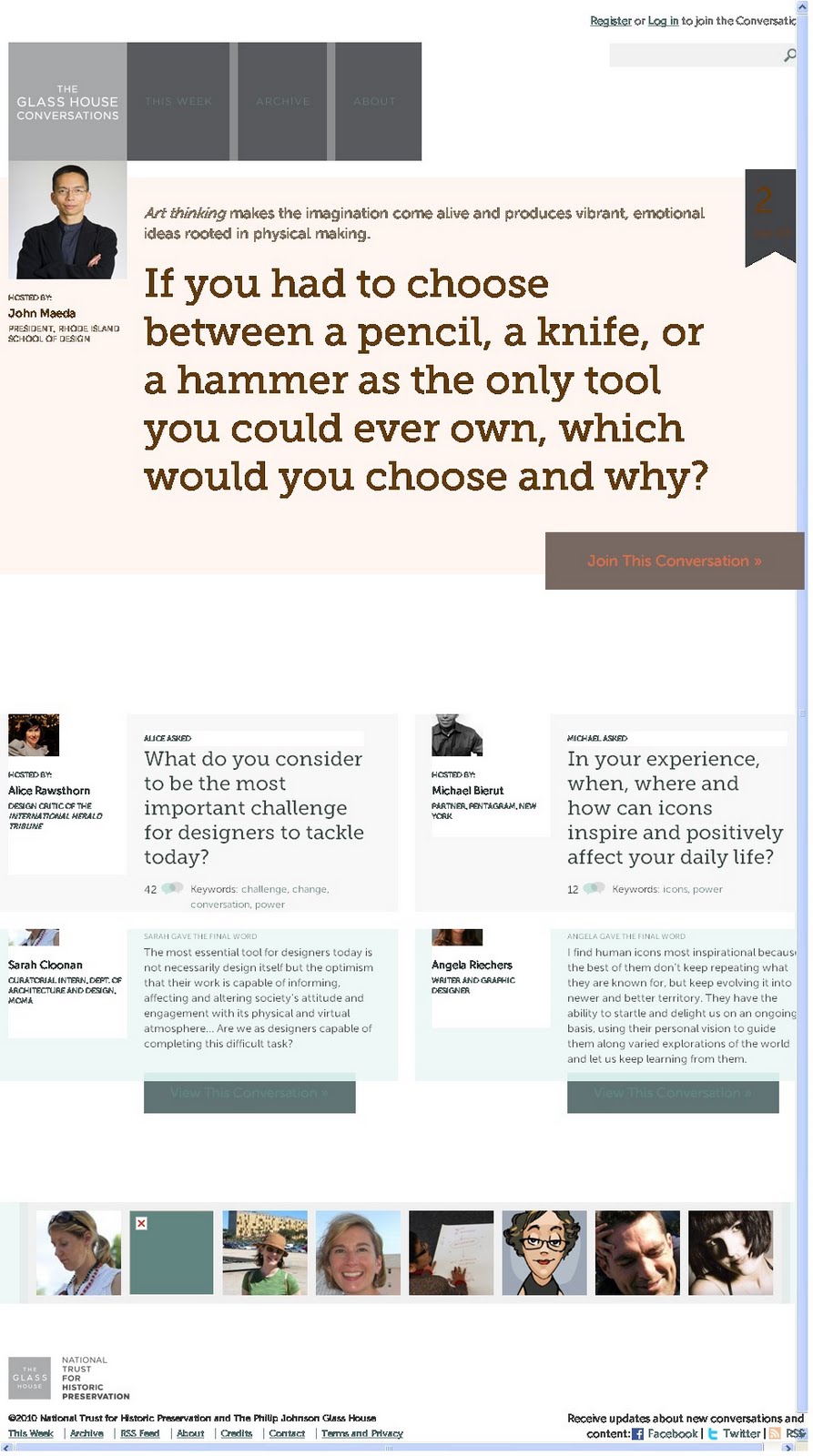
Now you can be one of the Glass House great minds. The legendary invitation-only Philip Johnson Glass House Conversations that brought together thought leaders in architecture, design and art  in the infamous New Canaan glass house is now open to the public, online of course.  Glass House Conversations is a website that continues the tradition, investigating what makes a great conversation in a regular, curated discussion sparked by provocative questions.

Each Monday, a host posts a question. People have only five days to respond, with conversations ending on Friday evenings. After comments have closed a “Final Word” is chosen from the replies. 

Now up: If you had to choose between a pencil, a knife or a hammer as the only tool you could ever own, which would you choose and why? There's two days left to give your answer on this one. Will you be the final word?   

This is a brilliant use of current technology and social trends  to communicate and assert  the Glass House as an influential force in design. How thought leading of them!  Applause.

What You Can Learn From Clinique's Poor PR Performance


Eeks. I always feel bad for anyone who gets any kind of bad PR practice "outing" in the media, like Clinique got from PRNewsers after putting a freelance trade reporter through hoops through their website.  The writer shares her full experience on her blog post "Tales from the Trade Press: Clinique's Press Office Hell."

Whether this was a case of neglect and badly outdated web interface with the media or an unnecessarily heavy-handed media relations response, the burning question is the same.  Why make it so hard?  We're not talking nuclear warhead decisions here! And, eh-ehm...its 2010. Technology has changed everything. 

Here's three tried and true principles this kind of bad PR performance can teach you: 

  • Never make it hard to be reached for media queries. There's no excuse not to be. Your website and blog should have a visible contact number or e-mail, and new affordable online newsrooms make it so easy to share  press releases, images and important facts about your business that make it easy for reporters to run with. 
  • Be responsive. Yes, it's tough keeping up, but in my book, responsiveness wins in the PR game and sticks with your reputation. 
  • Don't treat a freelance reporter or blogger, assistant editor or newbie  like he or she is second citizen. They're contribution to the news funnel is important and they may also land at some news outlet you'll be dying to be in.  Everyone deserves respect. Don't be a snob. 
Shame on Clinique. There's no reason a big lifestyle brand like this should have a problem answering a media query more quickly to personally discuss  the nature of the story and determine how best to give the writer her story. 

Bring Your Magazine Cover to Life with Your Smartphone


Augmented reality. That's what Time Out New York Kids Magazine is creating for their readers in their August issue as the first magazine using a technology that brings the cover to life with a multi-media component. Just shoot your smart phone at the cover to get a video. In this case, it's a video of  PS 22, the award-winning fifth-grade chorus from Staten Island. In today's game of trying to keep print titles in business, this technique is an inventive draw for readers and advertisers. Imagine what your favorite design or fashion magazine could do. 


What do you think? Would this influence your decision to purchase a magazine or newspaper? 


Buzz Kill: What Business Words Do You Love to Hate (and use)?

This post about the worst business buzz words used in 2010 is a great exclamation point to my recent post on writing press releases in which I advised to be vigilant against using cliches and "fluff" words that don't really mean anything.  Not surprisingly,  I regularly see and think about using the words that topped the list in meetings, releases, pitches, marketing copy and proposals.  I admit it. I love cliches. They're fun and so unbelievably on mark.  And in some cases, some of the overused buzzwords on this list, like synergy, are perfectly called for.  Some  personal yawners I work hard to not to overuse or use at all: innovative, synergy,  "hot" as in "season's hottest," strategic, "out of the box," and love as in "would love to."

Imagine if you're a reporter working with and reading words for a living? Do you want to be the rote pitch that crosses their desks? Break away from the expected. What buzz words are you tired of reading or try not to use?

Photo: The Risesmart Blog 

Press Release Pointers: Stop Romancing & Start Writing


I love writing press releases. The challenge of  synthesizing all the disparate facts and creating something that not only shares the news succinctly, but inspires and supports good stories and  brand positioning for my clients is exciting and rewarding.  Its not easy though. Crafting a press release should not be taken lightly, yet many businesses still churn out weak releases that fail to communicate key messages or are bogged down in fluff, buzz words and overstated phrases. Are you? Here's a few pointers to keep in mind the next time you write a press release:

Get to the Point Already
What are you talking about? If your title and first paragraph aren't telling me exactly what the rest of the release is going to be about, rewrite it. Think the good old  reporting pyramid. Write the most important facts up front first, and whittle from there.  And keep it relevant throughout. If you've got secondary, related news or a large amount of descriptive copy, consider a fact sheet or separate release.

What's Your Angle?
Without an angle, your press release will work like a misfired bullet likely to miss its target. An angle is what makes your news release matter to the media. You can develop different angles to suit each of the media you target, and you should.   Mine your story for the most relevant, compelling and interesting elements to lead with, always keeping in mind who you're pitching. A release for your regional magazine should highlight the local players, while one going to a niche magazine should speak to their editorial focus. My tip: Soak up a few articles from the media outlet you're pitching to get a feel for their tone and aim. Then go back to your release and rewrite it to suit their style and direction. 

Quote from the Heart, Edit with the Brain
Ditch the dry corporate speak like "we're excited to.." and challenge the tendency to just utter something that can just be stated in a factual sentence. Quotes are a great way to give life and movement to your press release. Think with your heart first. Then edit with your business brain. This is your place to say something with personality. Look to your your mission and positioning goals for guidance, and weave in something meaningful.

Stop the Gobbledygook
STOP using over used words like "innovative," cliches and  romantic language to describe your product or service.  These crimes are especially evident in the world of design, where style and aesthetic can be hard to communicate. Pretty adjectives should be monitored and tempered with real facts that give the readers a real picture. Keep the thesaurus and dictionary close to you.  Choose the perfect words to articulate your message, not the easy ones. You'll be more interesting and better understood.

Mind Your Business Messages
Yes, journalists really do use your press release when they write their stories. They rely on them for accuracy and ideas. So make it count. Aside from a calendar listing, a press release about news like your anniversary,  product announcement, or new business launch should be written with your brand position in mind. What are your key messages? What do you want to be known for? Can these be weaved into the angle, the title of your release, or used to create a great quote? It  may not be possible or relevant in every case, but the consistent, mindful communication of what your business stands for will stick in the minds of the media, and your audiences for the short and long haul. 

Was this helpful? Are there other challenges you've come across when writing press releases?
Good Old Fashioned Creativity from the ICFF Press Room


During her coverage of the ICFF, DesignMilk picked up some pretty clever press materials and shares some favorites in their post-round up report, including a really great business card by designer Ufuk Keskin which looks like his Sheetseat - a folding chair made from one piece of plywood. (below) One thing that's so much fun about doing PR for design and architecture businesses is that the creative element is always at play. I've had such fun exercising my creative bone plenty to design clever press and marketing pieces for clients. But over the past five years, those printed pieces have been replaced by digital disk and memory sticks more and more. Albeit economical and "cool" in its own right, it can't compare to the fantastic and memorable press kits (and branding)  created by good old fashioned printing and paper.


Photos: (top -bottom) Design Milk, Ufuk Keskin


Stop Pushing! PR is Organic, Not Forced


In June, my client Allan Shulman will be hosting a book signing at the historic Barcardi Building during the AIA National Convention for his new book Miami Modern Metropolis, and Architectural Record has enthusiastically signed on as a supporting partner. I’m particularly excited about this event. Not just because it will be held on the amazing Plaza or that it’s in Miami, but because it’s a result of one introductory meeting I arranged with the magazine’s editor months ago.

You see, Shulman was much more than just his book. He was extremely knowledgeable about Miami architecture and urban development themes and he had this fantastic way of getting you excited about it. I knew that his expertise would be greatly appreciated and resourceful to the editors and pitched a meeting in New York. Just as I suspected, Shulman blew them away, sharing intimate knowledge and leads that went well beyond his own architectural projects and helped them produce the content for their June issue. Not only will the magazine publish a book review, but Allan will be a featured interview on the magazine’s web site about Miami architecture, and he’s been asked to write a bylined article for the issue too.

PR is not forced, it’s organic. It flourishes when you’re strategically giving, rather than selfishly expecting. And it’s so exciting to watch. Without literally sitting in on editorial and business meetings, I couldn’t have developed and pitched all those ideas to the magazine. Nor was it my job to. It’s the editor’s job to consider the sources and use them to support their editorial and business goals. It’s my job to understand the media’s needs and be resourceful. With thoughtful strategy and good timing, Shulman now has a working relationship with one of the most esteemed architectural magazines on the market.

Instead of just asking “what can I get,” think about what you know and how you can help the media produce great stories. Then step back, let them do their job and watch the opportunities sprout naturally. Only then will you truly experience the organic nature of a good media relations campaign.